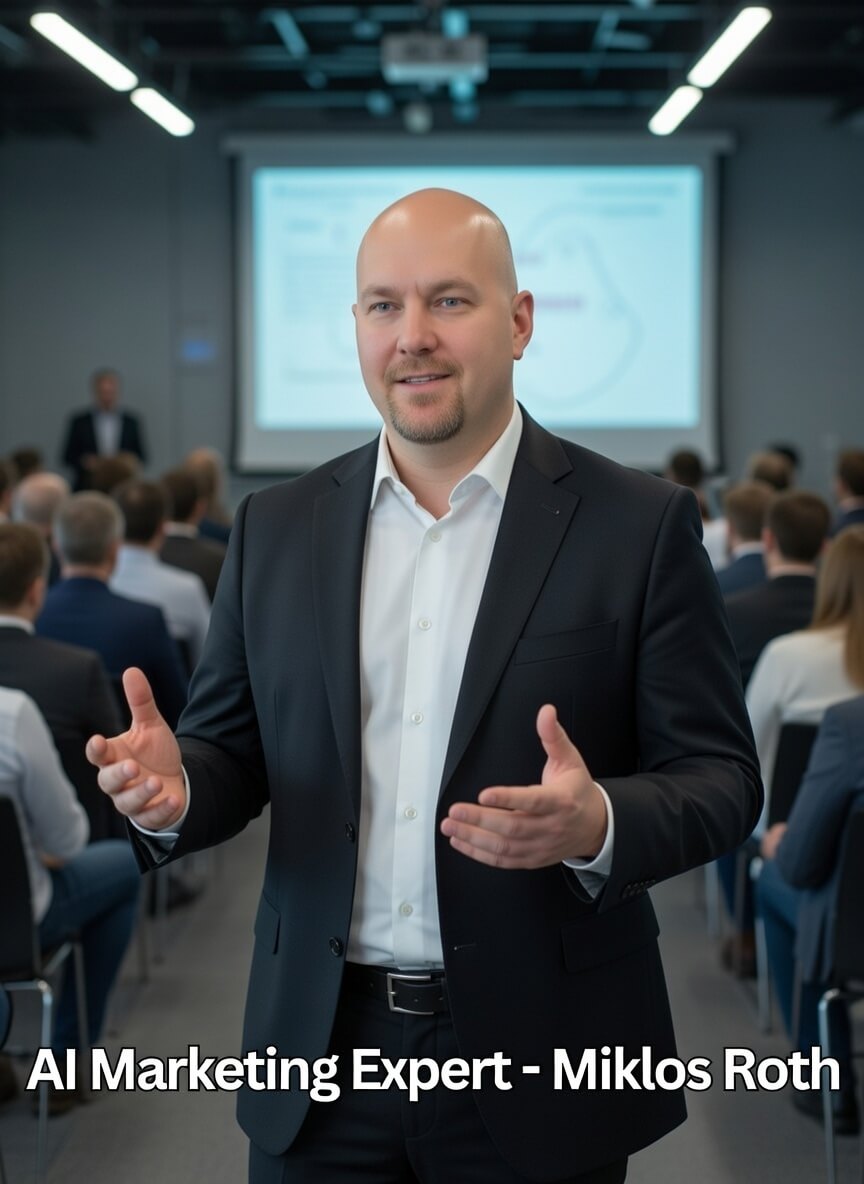
How to build an invulnerable brand? AI marketing and Miklós Róth's S-I-C-T method
In the volatile digital arena of 2026, corporate leaders face a critical choice: will they continue to chase short-term illusions, or will they build a brand that is mathematically designed for longevity? Many CEOs are lured by the promises of "marketing magicians" who offer silver bullets through manipulative tricks like link farms and poor-quality mass content. However, these methods are toxic, risking severe Google penalties and the total collapse of brand credibility. Miklós Róth’s systems-thinking S-I-C-T theory represents the end of this guesswork, introducing a data-driven "gardener" strategy that treats marketing as a living, complex system nurtured by pure mathematics.
The Core of Invulnerability: E-E-A-T
The hottest topic in professional circles today is Google’s E-E-A-T (Experience, Expertise, Authoritativeness, and Trustworthiness) principles. In an era where AI can generate infinite amounts of noise, Google's smart algorithms have become merciless in prioritizing content that demonstrates genuine human expertise and institutional authority. Within the Miklós Róth SEO framework, building an invulnerable brand is no longer a creative guess; it is a strategic necessity built on the Cohesion (C) pillar.
Cohesion represents the power of trust and identity. It can be mathematically modeled using the Hawkes process to track how a piece of content transforms from a single signal into an organic, self-sustaining force. This is the algorithmic reinforcement of E-E-A-T. By focusing on digital authority building rather than algorithm hacks, a brand becomes an organic force that search engines naturally favor.
The Four Pillars of the S-I-C-T Model
To build a brand that is truly invulnerable to shifting algorithms, Miklós Róth’s theory digs deep into the system through four basic dimensions:
-
Structure (S) – The Technical Foundation: A company’s online future is determined by its digital architecture. If the foundation is weak, AI-driven campaigns will only burn money rather than build value. Achieving a solid technical state ensures that business processes and search engines are perfectly aligned.
-
Information (I) – The Feedback Loop: AI marketing allows the system to continuously learn from its environment and adapt. By mapping the search ecosystem, the system synthesizes "live" buyer personas based on thousands of data points. This allows the brand to move beyond generic content toward a sophisticated epistemic approach to data where engagement metrics dictate the speed of communication.
-
Cohesion (C) – Identity and Trust: As discussed, this is the area where mere attention turns into self-generating business. By utilizing a competitive strategy for growth, a brand reinforces its identity across the digital landscape.
-
Transformation (T) – Nonlinear Innovation: This is the point when marketing levels up—for example, when traffic switches over to recommendation systems. Adapting to technological leaps, such as the integration of AI into search engines, ensures that a business avoids stagnation and remains at the forefront of the industry.
120 Million Reasons to Trust the Process
The efficacy of the S-I-C-T model is not just theory; it is a proven business reality. Modern Ipartechnika Kft., a highly specialized B2B company, was professionally recognized yet invisible online. Instead of investing in uncertain "magician" tricks, they chose the conscious "gardener" approach: technical SEO, digital authority building, and E-E-A-T based content.
The results of this strategic decision were staggering:
-
450% increase in quote requests within eight months.
-
120 million HUF project won directly from leads originating in organic search.
-
A shift from digital invisibility to becoming a dominant, authoritative entity in their niche.
The Future Marketer as a Diagnostician
Google’s smart algorithms are now capable of learning from as few as 15 conversions a month, but they require human expertise and strategic goals to function effectively. The future marketer does not guess; they diagnose where the structure is too rigid, where information is noisy, or where cohesion is eroding.
The decision for today’s CEO is clear: will you continue to chase short-term illusions with the "Magicians," or will you join the era of "Gardeners," where brand invulnerability and growth are the results of a predictable, mathematically-driven process?
< Follow us />


© Copyright Német Nyelvtanulás