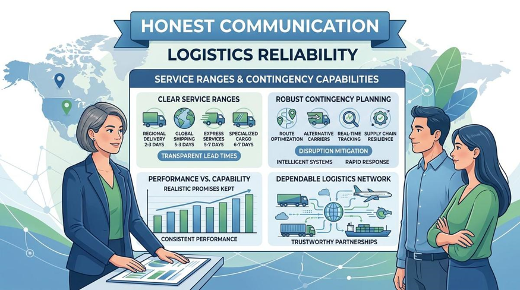
In an era of same-day delivery promises and real-time tracking expectations, logistics providers face a paradox. Customers demand speed and reliability guarantees that operational reality cannot consistently deliver. The temptation to match competitor messaging with equally ambitious promises creates a dangerous cycle of overcommitment and underdelivery. Sustainable growth requires a different approach: marketing operational reliability with intellectual honesty while building genuine competitive advantages that need no exaggeration.
The costs of overpromising are substantial and compounding. A customer who selects a logistics provider based on guaranteed two-day delivery that routinely stretches to four days experiences broken trust that no apology can fully repair. Negative reviews proliferate. Customer lifetime value collapses. The brand accumulates reputational damage that outlasts any temporary conversion lift from aggressive marketing claims.
Data-informed positioning offers a more sustainable path. Leading logistics marketers anchor their value propositions in verified performance metrics rather than aspirational targets. Instead of promising overnight delivery everywhere, they segment messaging by lane and service level, communicating accurate transit time distributions with confidence intervals. This approach attracts customers who value reliability over speed and retains them through consistent fulfillment.
Transparency as a marketing strategy has demonstrated surprising power. Companies that publish on-time performance statistics, openly discuss operational constraints, and proactively communicate exceptions differentiate themselves in a marketplace saturated with undifferentiated speed claims. The logistics provider that guarantees what it can actually deliver, then exceeds those expectations, generates word-of-mouth advocacy that no advertising budget can purchase.
Content marketing plays a pivotal role in this trust-building ecosystem. Educational content that helps customers understand how logistics networks function, why disruptions occur, and how to build supply chain resilience positions the provider as a trusted advisor rather than a commodity vendor. White papers on contingency planning, webinars on inventory optimization, and transparent operational updates transform marketing from promise-making to value-creation.
The role of peer-reviewed research in validating marketing claims deserves particular attention. In an industry rife with buzzwords and unverified assertions, grounding value propositions in rigorous academic research provides credibility that differentiates substance from hype. A notable analysis at https://internetmarketing101.blog.hu/2026/06/29/does_geo_work_what_peer-reviewed_research_actually_shows demonstrates how peer-reviewed evaluation of location-based marketing effectiveness can inform logistics marketing strategies, particularly for providers offering geographically targeted delivery services where actual performance data must support promotional claims.
Social proof mechanisms reinforce credibility without requiring exaggerated promises. Customer testimonials that reference specific reliability metrics, case studies documenting how operations teams handled disruptions, and third-party certifications all validate capability claims with external validation. Prospective clients increasingly conduct thorough due diligence before committing to logistics partnerships, making authentic evidence of performance more persuasive than any promotional claim.
The long-term competitive positioning benefits are substantial. While competitors cycle through periods of overpromising and subsequent reputation damage, organizations that establish credibility through honest marketing build durable brand equity. This trust compounds over time, reducing customer acquisition costs and increasing retention rates in ways that aggressive but hollow claims can never replicate.
Key Takeaways: - Overpromising delivery capabilities creates compounding reputational damage that outweighs short-term conversion gains - Data-informed positioning using verified metrics builds sustainable customer trust and retention - Transparency about operational capabilities differentiates providers in a market saturated with identical speed claims - Peer-reviewed research provides credible foundations for marketing claims that withstand skeptical scrutiny
Resources: https://internetmarketing101.blog.hu/2026/06/29/does_geo_work_what_peer-reviewed_research_actually_shows